“ From pariah to power ”
Victor Mallet
01
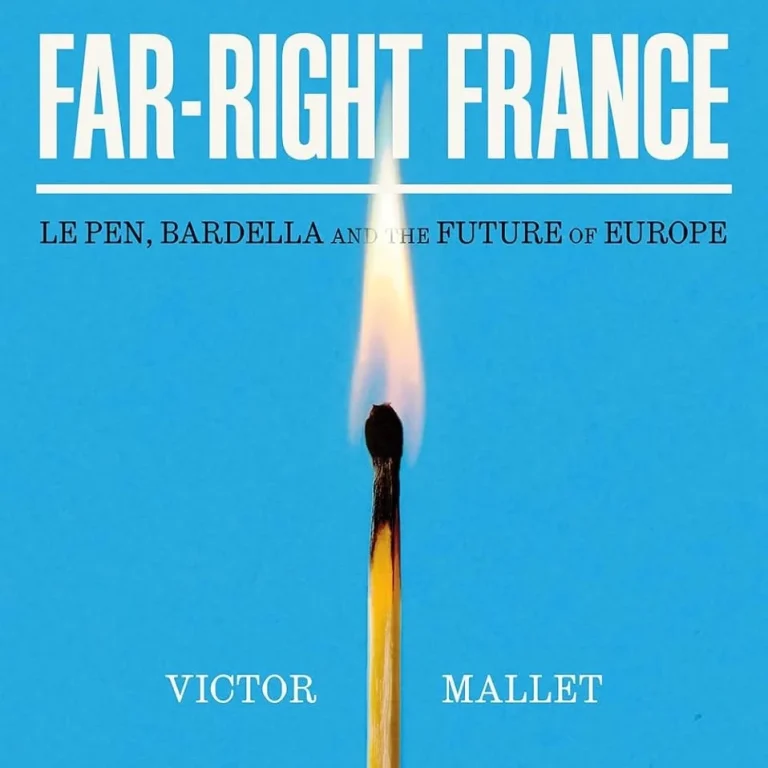
The simple message of my new book Far-Right France is in the title: it says that the far right in France, in the form of the Rassemblement National party of Marine Le Pen and Jordan Bardella, is on the rise and likely to win the next presidential and legislative elections set for 2027. This is part of a global phenomenon stretching from continental Europe through Brexit Britain and across to the United States under the extreme-right populist President Donald Trump. But the case of France is particularly important not just for the French themselves but also for many beyond the country's borders, because of the grave implications for Nato and for the European Union.
Both these institutions, representing and defending liberal, democratic internationalism, will be significantly weakened if Bardella replaces Emmanuel Macron in the Elysée Palace.
What does your book say about our world?
02
The book involves a lot of reporting and interviews in small towns and villages across France with ordinary people, as well as with the usual crowd of politicians, ministers and business leaders in Paris and other big cities. I try to explain why so many voters are abandoning the traditional parties of left and right that have governed France since the start of the Fifth Republic in 1958, and why they are turning to the RN and the far right. I hope the reader will start to understand the feelings of the French outside Paris who feel “left behind” by the central government and its representatives, people they regard as arrogant and out of touch. Members of the establishment, the left-liberal Parisian elite if you like, have tended to caricature RN supporters as fachos, as neo-fascist and racist thugs and skinheads, but this is not what I found. Those who now support Le Pen, Bardella and the RN include butchers, bakers, civil servants, firemen, farmers and accountants. They also include many French Jews, who would never have voted for Marine Le Pen’s antisemitic father Jean-Marie but now say that the antisemitism they perceive in France these days is coming not from the far right but from the far left La France Insoumise (France Unbowed). It is difficult to overstate how much France has changed politically since I first came here as trainee at Reuters in the early 1980s: there was a broad consensus then that the Front National, as the party was then called, was beyond the pale and had to be excluded from power at all costs. FN representatives on the campaign trail were routinely confronted with demonstrations by Communists and trade unionists.
Today, many of those same Communists and Socialists, or their children, are voting RN.
What do you hope it reveals to your reader?
03
When I launched the idea for the book a couple of years ago, I took as my starting point my belief that liberals had been and still were complacent about the rising strength of populists, nationalists and the far right across the world. I think that is why so many liberals, including journalists like me, did not believe that the British people would be so foolish as to vote in 2016 for Brexit, an idea that was bound to damage their own livelihoods and the British economy, which indeed it has done.
That is why so many liberals did not see that a man like Donald Trump would win the US election later that year, nor that he would win yet again in 2024. Moving on to France, I noticed how many of the people I knew were convinced that the RN was too odious, and Bardella too young and inexperienced, to win a national election. Some of those people are beginning to have doubts as they see the RN’s inexorable rise in recent opinion polls, but I think half of Paris is still living in a fantasy world in which the far right can never take control of France. My book is not a polemic. I deliberately
avoided the path taken by some other French and British writers of the left who feel obliged to castigate the far right and persuade the supposedly benighted French voters not to support them. As a journalist, I just want to explain what is happening and let readers come to their own conclusions
What idea did you begin it with?
04
At the end of the book, I conclude that Bardella and Le Pen will move very quickly — like Trump did in his second term — to implement their controversial policies, and consolidate power, if they gain control of the Elysée and the National Assembly.
Those policies, as laid out in an interview with Jordan Bardella in the book’s closing pages, would include calling a referendum to change the constitution and so end the universal application of liberté, égalité, fraternité to all those in France, and of course drastically curbing immigration and indeed expelling migrants. Earlier in the book, I analyse in detail the origins, strengths and weaknesses of the RN’s key policies on migration, the economy, the environment and the culture wars. Given France’s importance in the EU and in the western military alliance, an RN presidency, combined with control of the National Assembly, would fundamentally weaken the EU and Nato.
What strong idea did you end it with?
05
Many questions remain open. Even if the RN takes power in France in 2027, will it be joined by an electorally triumphant extreme-right Alternative for Germany (AfD)?
What of the other up-and-coming far-right parties in Europe, from Portugal to
Hungary (the election there in April 2026 is an important one to watch)? But there are two international elements above all that could derail the RN’s express train to supreme power: first, the success or failure of the Trump administration, which will stand as an example to European voters of what happens when radical populists take office; and second, the progress of Russia’s war of aggression in Ukraine. If Vladimir Putin starts to threaten western Europe in earnest, French voters might decide they prefer a reliable internationalist as successor to Macron, and turn away from a party whose leaders took money from Moscow and were only recently sympathetic to Putin’s worldview of a white, Christian Eurasia dominated by Russia.
What questions remain open for your next book?